Is AI Killing Critical Thinking?
Viplav Baxi
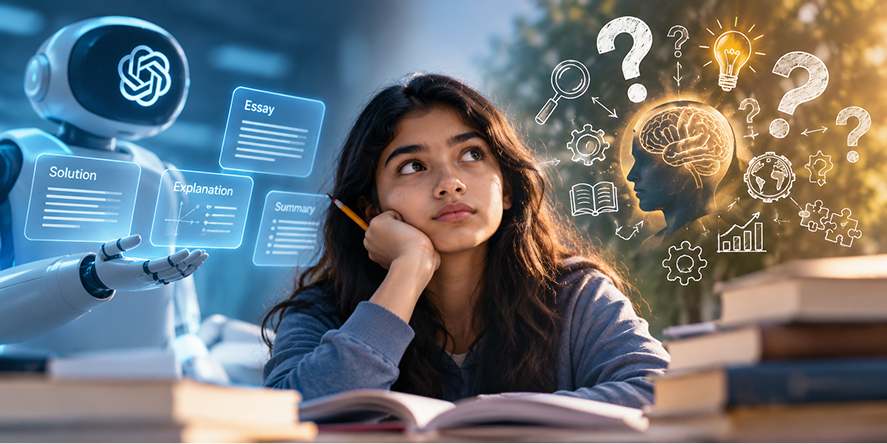
We have never had easier access to answers. But are we getting better at thinking?
Generative AI can write essays, solve problems and explain complex concepts in seconds. Yet, as AI becomes increasingly capable, we face a fundamental question: are we using it to strengthen human thinking, or to outsource it?
There has been intense debate over this question across all forms of education and training in the past couple of years. The latest PISA results give us another reason to pay attention.
The OECD's PISA 2025 results, released in September 2026, paint a sobering picture. More than 760,000 students aged 15 across 91 countries and economies participated in the assessment, which measures their ability to apply knowledge in mathematics, science and reading to real-world challenges.
The findings? OECD-average performance has reached its lowest recorded levels in all three core subjects. Reading has seen particularly steep declines, while mathematics has continued to fall. Science performance has also declined over the longer term, although it remained more stable between 2022 and 2025.

Over the past 25 years, we have seen a decline, but most sharply between 2018 and 2025. There are two major impacts that we must take into account - after all why must a stably performing world average suddenly fall into steep decline?
The COVID Impact
The impact of COVID cannot be understated. It could be comprehensively argued that its impact shook an educational system and impacted the generations of those 15-year-olds who took the PISA tests. In India itself, millions of children would have lost close to a year’s worth of learning. The issues were exacerbated by lack of infrastructure, access to technology and capabilities of all stakeholders to manage the shift to online systems.
AI Impact
Alongside the continuing effects of COVID, educators are asking whether some uses of AI reduce students’ opportunities to practise thinking. OECD findings on the relationship between AI use and performance show a complex picture:
PISA data show that Science students who use AI for specific schoolwork tasks, such as summarising texts, drafting or conducting research, attain lower scores in science than students who do not use AI. These relationships do not necessarily imply a negative impact of AI use on science performance, but may reflect a complex mix of who adopts AI and how they use it. It also suggests that moderate and intentional use of AI for schoolwork and learning may be positively related to student performance.
- PISA 2025 Results (Volume I)
The PISA report also suggests that "among students who use AI for schoolwork for a general purpose (“to help me learn”), those who report moderate use score slightly higher in PISA than students who use it either rarely or intensively."
These findings raise questions about how learners evaluate information and explain their reasoning. They do not, on their own, show that AI causes a decline in critical thinking.
Cognitive Offloading
Cognitive Offloading means delegating some functions of thinking and memory to external tools. It can be useful, but educators need to consider whether it displaces practice learners need. This has happened continuously with technology innovation. For example, we reduce computational abilities when we are able to pay easily with UPI (no computation of currency change), or pathfinding capability with Google Maps, or assignment responses (using AI).
Cognitive debt
Cognitive Debt describes a concern about the future cost of repeatedly relying on AI for activities through which people develop their own capabilities. Schools should examine where assistance supports learning and where it may displace essential practice. Practices that promote effective long-term use of AI, should be promoted, and unnecessary delegation should be avoided. When and where to use AI should also become an important and conscious decision.
Accountability Deficit
By treating AI output as the "truth", there have been many instances where hallucinations in AI have led to wrong conclusions or decision making. We have all heard, for example, about research papers or legal statutes being cited that never existed! A Microsoft Research study surveying 319 adult knowledge workers found that greater confidence in AI was associated with less self-reported critical thinking, while greater task-specific self-confidence was associated with more. This was a study of adults’ reported experiences, not a measure of school children’s skill decline.
Failure of traditional assessment
Some existing assessment methods need reconsideration. With improving AI models, the ability of a student to expeditiously complete an assignment or complete coursework activities, has become more powerful. The burden of assessment has in a way shifted from the student to the teacher, who now has to discern what is AI from what is not. This also brings in a trust deficit in the classroom, and frustration for both sides in the process.
Lack of integration in curricula
Where AI use is not explicitly addressed in teaching and assessment, students may use it without shared expectations. This means that institutions do not have a say in how AI should be used. This can be a cause of the misalignment between teachers and students, and also the educational leadership. For ages we have assumed that the learner's submitted task was reflective on internal learning. But that is simply untrue - "successful performance is no longer sufficient evidence of durable human capability".
Way Forward
Research and real-world experiences shows that, used properly, AI can help enhance outcomes. This means that if humans co-create outcomes with AI, by using their own curiosity, critical and computational thinking, and other abilities, rather than relying on cognitive offloading, then outcomes can be significantly enhanced. Some of the good practices could be as follows.
Encourage active questioning of AI generated outputs
Let your students and teachers evaluate claims, identify evidence and perform reasoning. Ask them to evaluate claims, verify evidence, identify inconsistencies and explain their reasoning. Build time into lessons for students to challenge AI-generated answers rather than simply accept them. While this is common sense, space and time must be made in the calendar to make this possible.
Integrate AI tools
AI should be made part of the lesson or assessment where applicable, making it an explicit part of the assessment structures themselves. Teachers should interrogate chat/AI use transcripts to understand how students are thinking, and to also develop an understanding of how best to work with AI. Where appropriate, examine the interaction and reasoning behind an answer, not just the final submission. AI interaction records can support reflection, but they should complement rather than replace direct evidence of understanding.
Responsible use of AI
The culture of using AI as a collaborative tool should be promoted. Position AI as a thinking partner, not an unquestionable authority or a substitute for effort. Students should learn when to use it, when to challenge it and when to work independently.
Redesign Assessments and Learning
Redesign Assessments to integrate AI tools, but flip the classroom into spaces for collaboration and critical thinking. Move beyond assignments that can be completed entirely outside the classroom. Combine AI-assisted projects with discussions, oral explanations, in-class problem-solving, reflection and collaborative tasks that reveal how students think.
AI Literacy and Skills
Equip students and teachers with better understanding and skill on AI itself so that they can work in tandem on projects and group work. Both groups need to understand the technology's capabilities, limitations, biases and risks. Teachers also need the professional development and institutional support to redesign learning, not simply add another tool to an already crowded technology landscape.
I think the more important question is - What do you think? Are our current teaching and assessment practices preparing students and teachers to think independently in an AI-enabled world?
Further reading
OECD PISA 2025 results →Microsoft Research on critical thinking →

Education Researcher & Author
Founder, AmplifiU